
Keep sensitive work within your boundaries
Set which models and destinations each workflow may use. Apply the same data boundaries to fallback paths.
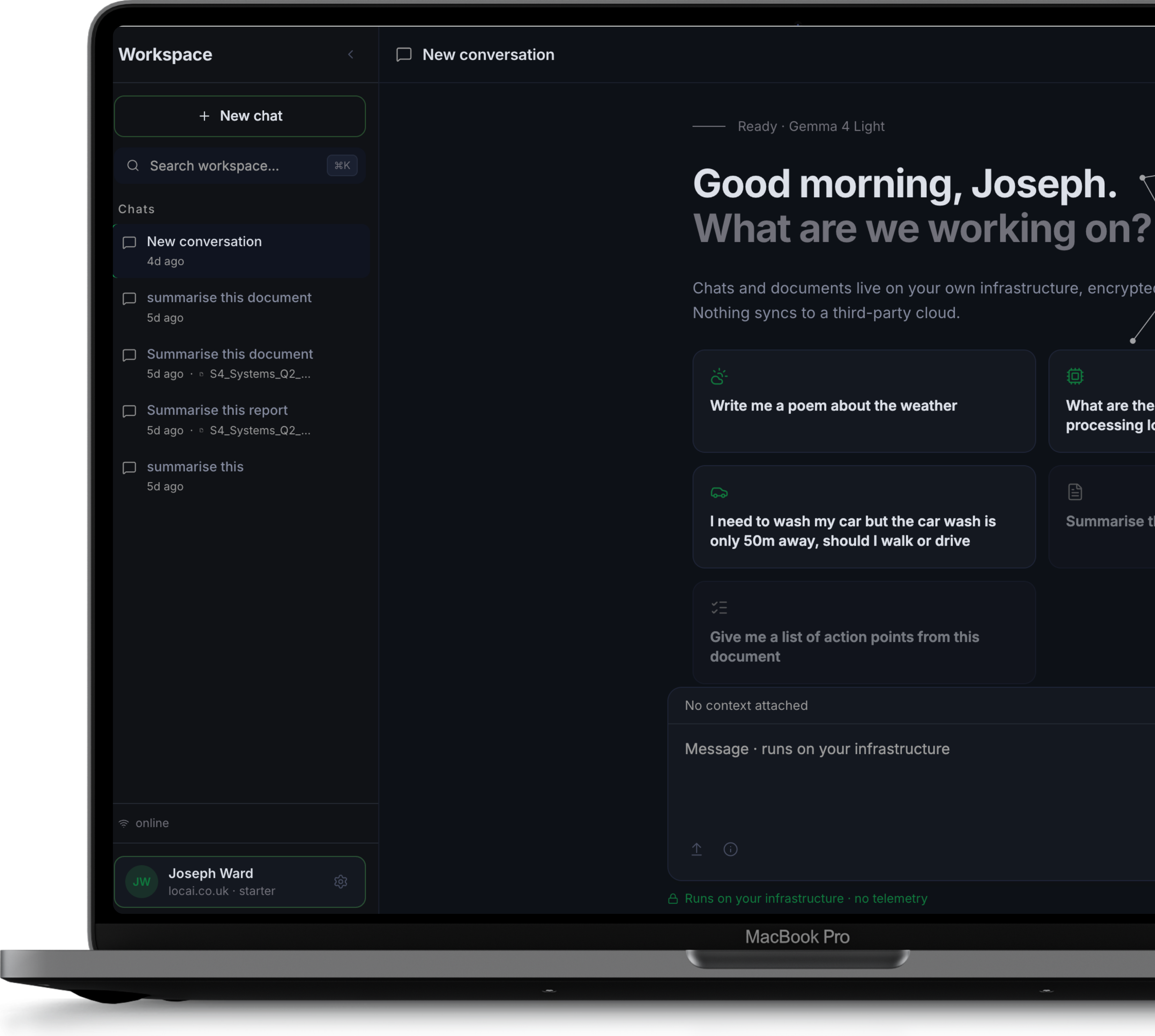
Give employees one place to work with AI, while your organisation controls the models, data boundaries and spend. Aventail™ Enterprise connects Workspace to your own hardware and approved frontier APIs, with Aventail™ Link applying your policies to each request.
Security
View trust centre
Give teams a private AI workspace for conversations, documents, data and workflows. Run supported models on your own infrastructure and choose when approved cloud APIs may be used.
People can get on with their work while Aventail™ Link handles where requests run under the policies you set.
Keep sensitive work on approved infrastructure, use existing capacity for suitable requests and allow frontier APIs when the work needs them.
A permitted model runs on an on-premises machine equipped with Aventail™ Link. The policy keeps this request within approved infrastructure.
Set which models and destinations each workflow may use. Apply the same data boundaries to fallback paths.
Use your devices and servers for suitable work, and set when paid APIs are allowed. Local execution still has hardware, energy and platform costs.
Use Aventail™ Control to distribute models, policies and keys, then review device and routing activity across machines running Aventail™ Link.
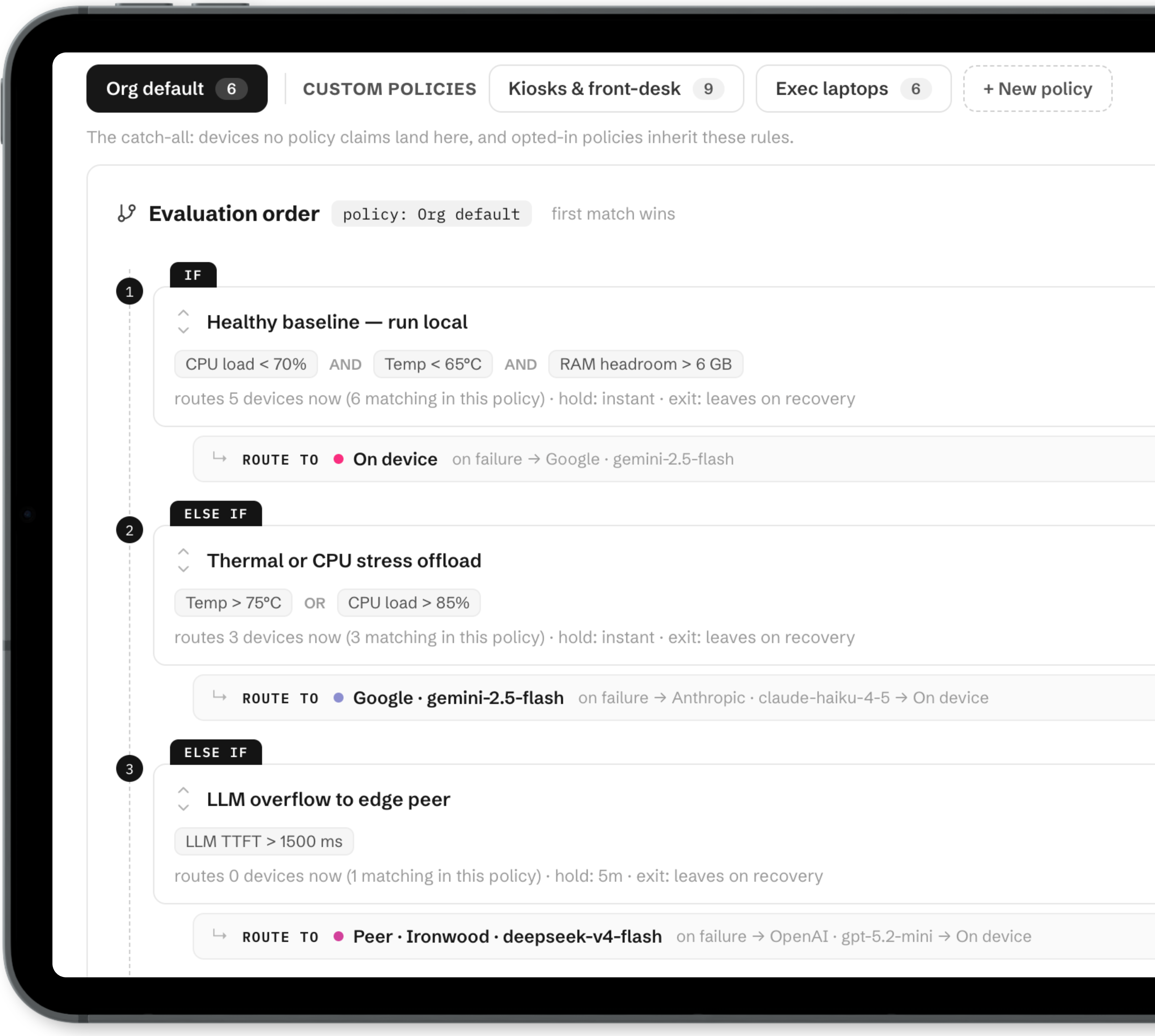
Aventail™ Control lets you manage routing rules and fallback order, with configuration distributed ahead of requests.
The hosted Aventail™ Control service receives device and routing events, not prompts or responses. An approved external provider processes the request through your organisation’s own account. Aventail™ Control can also be hosted on your infrastructure.
Local execution keeps inference on the machine. A policy-permitted remote destination receives the request sent to it. Hosted Aventail™ Control receives management, device and routing events, not prompt or response bodies. Local execution alone does not determine application storage, analytics or plugin behaviour; review those settings. Read the architecture and usage analytics guidance.
On an eligible local device, another approved reachable peer running Aventail™ Link, or on-premises, private-cloud or provider machines running Aventail™ Link. Approved frontier APIs run at their providers, using your own provider accounts. Model support, connectivity, access and your policy determine which destinations are eligible.
Yes. Integration with the inference engine lets Aventail™ Link combine model suitability and performance with device capacity and conditions, query content and organisation policy in a local decision. Constraints restrict eligible destinations before preferences select among them.
Support depends on the runtime version, operating system and architecture, model engine and format, and available resources. Current documentation lists Mac Apple Silicon, Linux x64 and Windows x64 packages; package availability does not mean every model or machine is supported. Read the compatibility guide.
Aventail™ Control configures and distributes policies. Aventail™ Link evaluates requests locally and applies restrictions to destinations and fallback paths. Aventail™ Control stays outside the inference request path. Read how Aventail™ works.
Yes. Run supported open-weight models on your own compute and permit external calls through your own provider accounts. The same policy layer governs those choices without requiring an all-cloud or all-local deployment.
Review the trust centre for SOC 2 Type I, the DPA, the Privacy Policy and the security documentation alongside your deployment requirements.
Bring one employee workflow, your data requirements and the hardware or model services you already use. We’ll map a practical starting point.
Choose a time with our team.We use optional cookies and tracking to identify visiting companies and load our contact form. Cookie policy